
Church of St. Ursula
Located within the historic stonework of one of Cologne’s twelve great Romanesque churches lies one of Europe’s most unusual and captivating memento mori spaces.
The basilica stands on the former grounds of a Roman cemetery. Archaeological excavations beneath the church have uncovered Roman graves, sarcophagi and masonry, linking the site to an active burial ground between the 1st and 4th centuries. Because of a 4th century inscription embedded in the Gothic choir, known as the ‘Clematius’ inscription, it is thought that a small Christian memorial chapel stood here before the first church.
According to medieval legend, St Ursula was a beautiful Christian princess who travelled from Britain to Rome with her 11,000 virgin companions. The story evolved during the early Middle Ages and spread across Europe. In fact, when large quantities of bones were discovered in the old Roman cemetery in 1106, they were believed to be the remains of Ursula and her entourage. They, according to the legend, stopped in Cologne on their return journey and were martyred by the Huns after Ursula refused a marriage proposal from their leader. This discovery transformed the site into a major pilgrimage destination. In the wake of these finds, a new Romanesque church was constructed in the 11th and 12th centuries, forming the core of the basilica that stands today. Over the centuries, the church developed and expanded, most famously with the Golden Chamber, where bones from the cemetery were arranged into intricate devotional displays. There is, however, no historical evidence that the bones belong to St Ursula’s and her companions, nor that there were truly 11,000 of them (the number may stem from a medieval mistranslation and more likely refers to just eleven). The far more plausible scenario is that the remains come from women, men and children buried over time in the Roman cemetery. The Golden Chamber is remarkable because it shows how myth, archaeology, religion, pilgrimage and art can overlap and shape one another.
By the 17th century, the existing reliquary space could no longer accommodate the growing collection of bones and so during 1642 and 1643, the Golden Chamber was commissioned, funded by the wealthy Cologne official Johann von Crane and his wife, Verena Hegenmüller. The altar was consecrated in 1644, but the room continued to be furnished and decorated for decades to be eventually completed shortly before 1700, when the delicate golden ornamental “veil”, that gives the chamber its name, was installed.
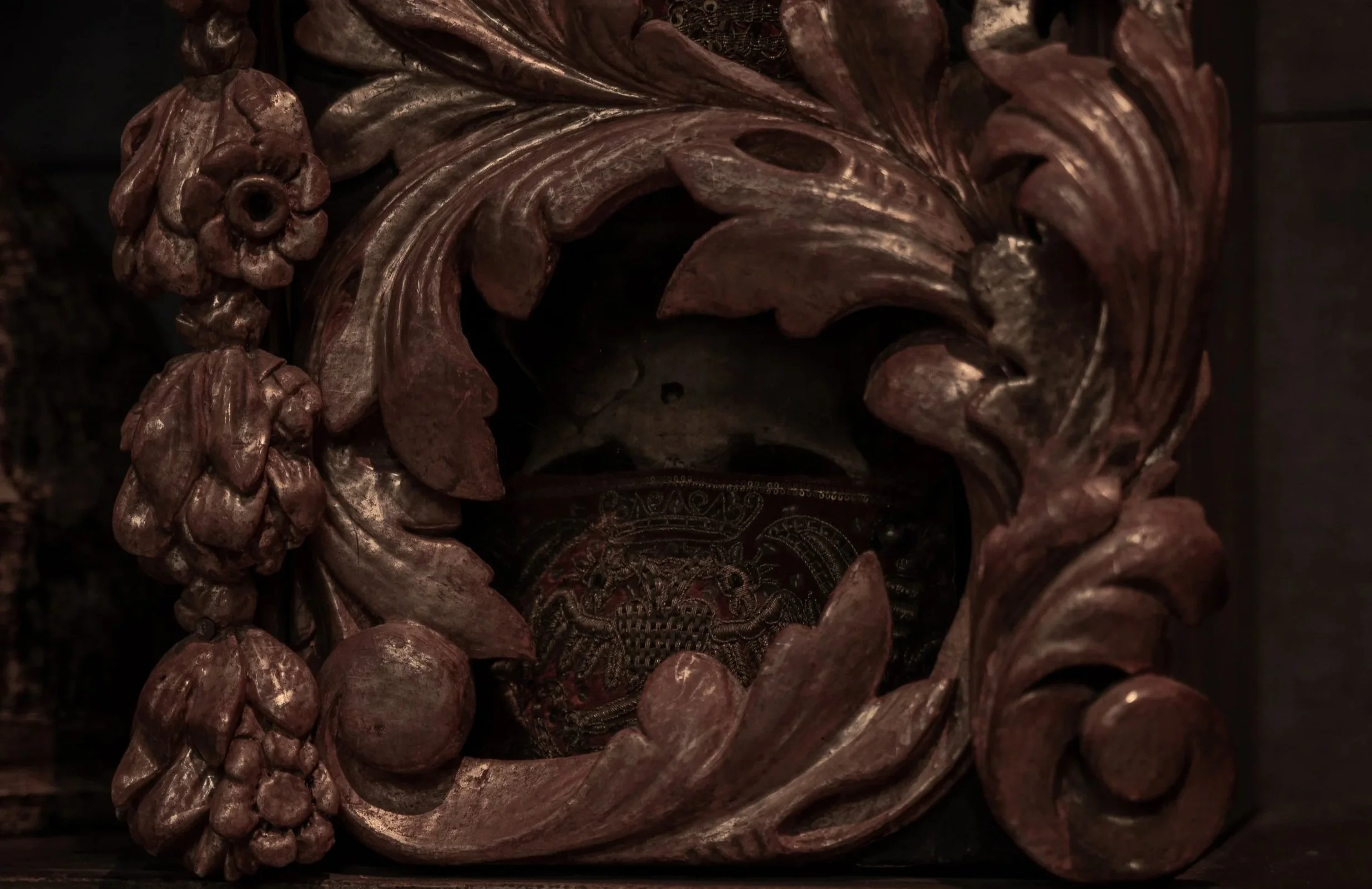
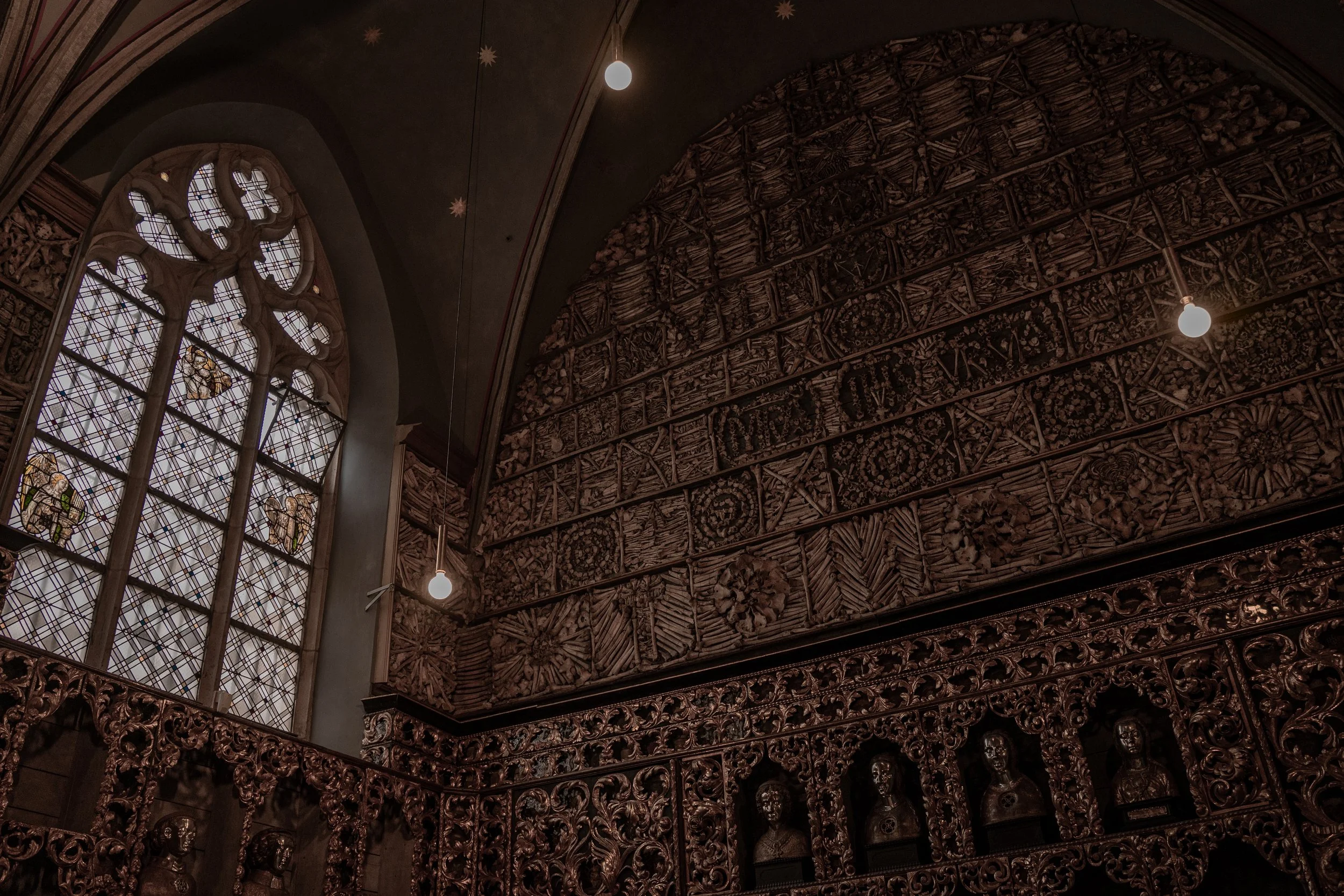
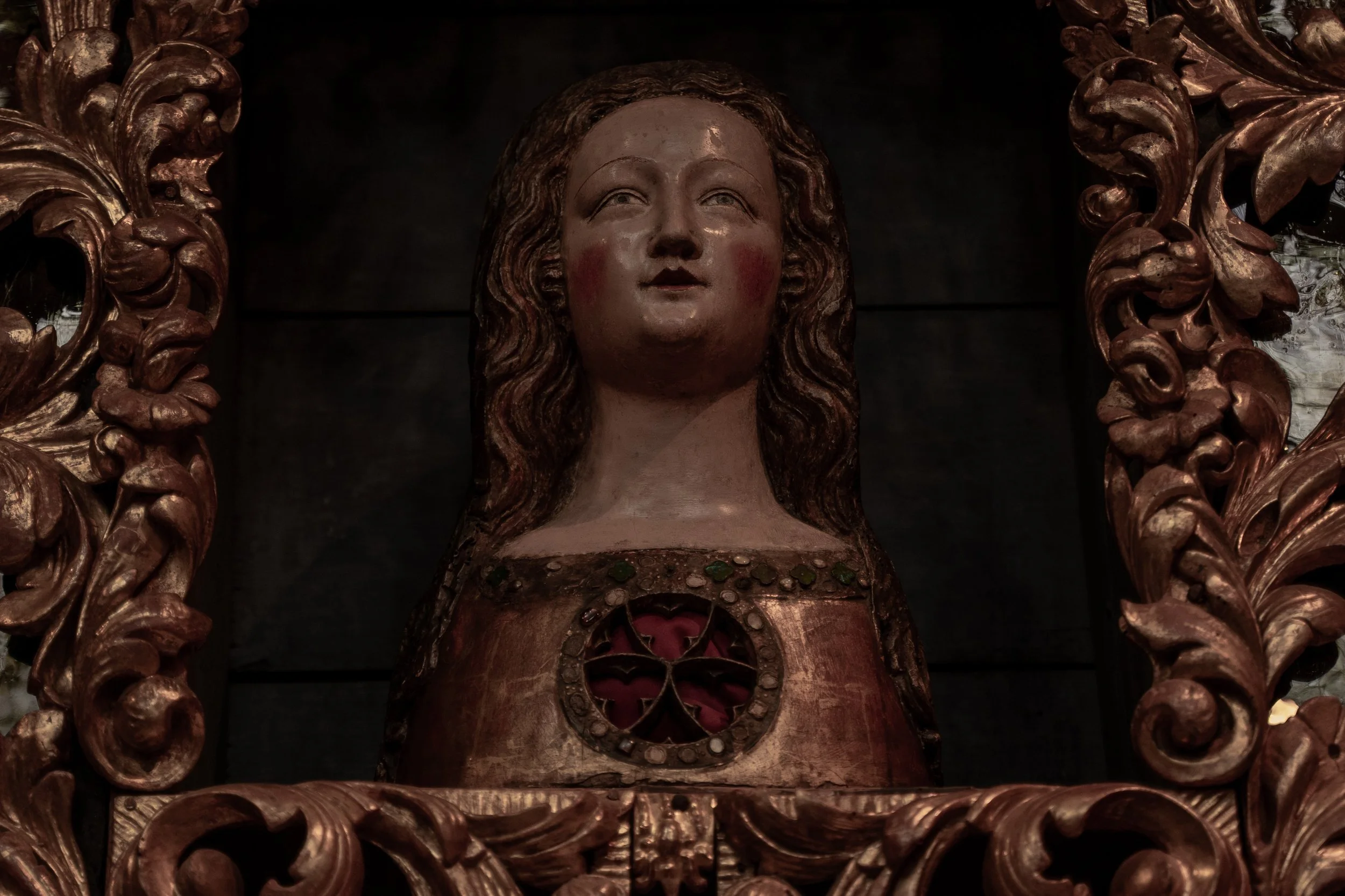
The upper areas of the walls are covered with real human bones, carefully arranged into elaborate mosaics of zigzags, words and swirls, fixed with small metal wires. Vertebrae, ribs, leg bones and other fragments form foliage, flowers, geometric ornaments and inscriptions. Above the altar, larger bones spell out the words “S. Ursula pro nobis ora” — “St Ursula, pray for us.” The walls are also adorned with more than one hundred reliquary busts, created over several centuries, with the oldest dating back to the late 13th century. Many appear as serene female figures, although some hold weapons, their bodies covered in elaborate decoration. These beautiful pieces are effectively containers, which open to reveal skulls or other relics housed inside the head or chest. Look closely and you’ll also see placed behind glass, skulls woven into the design of the leafed gold ornamentation. Some are partially obscured, wrapped in richly embroidered red velvet, while others are more immediately recognisable. Above, a sky‑blue vaulted ceiling is studded with eleven gold pointed stars. The contrast is deliberate and powerful. Below is the physical world: skulls, bones, bodies and death. Above is an idealised heavenly realm, with the gold stars creating a celestial atmosphere. The effect is Baroque sacred drama. Rather than presenting religious ideas quietly, the room makes them exaggerated and theatrical. It wants you to feel emotion: to experience awe, wonder and to act as a memento mori reminder.
Although St Ursula’s church suffered serious wartime damage, the Golden Chamber survived remarkably well. A concrete protective ceiling had been installed above its vault early in the bombing campaign, helping to shield the chamber and its precious contents.
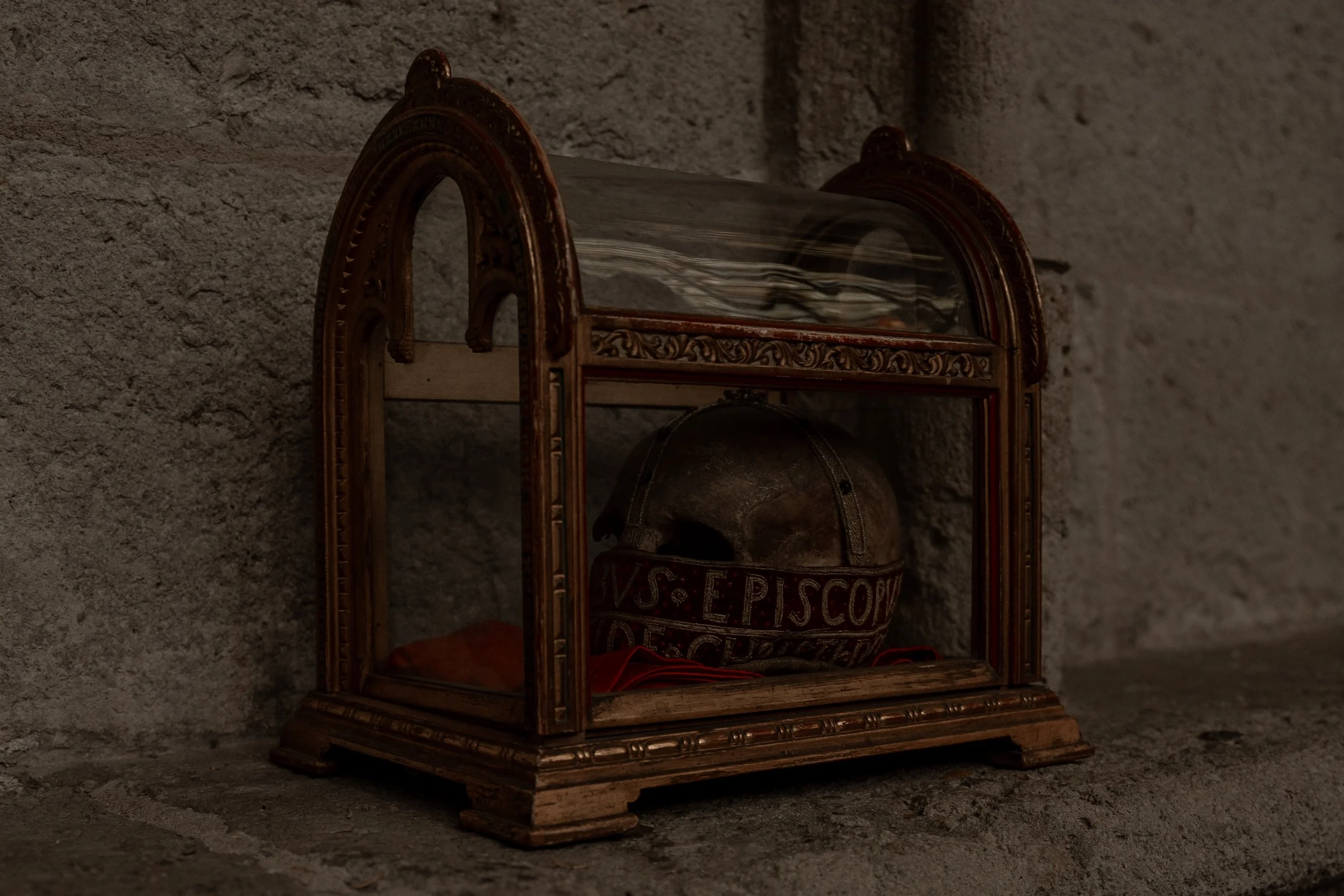
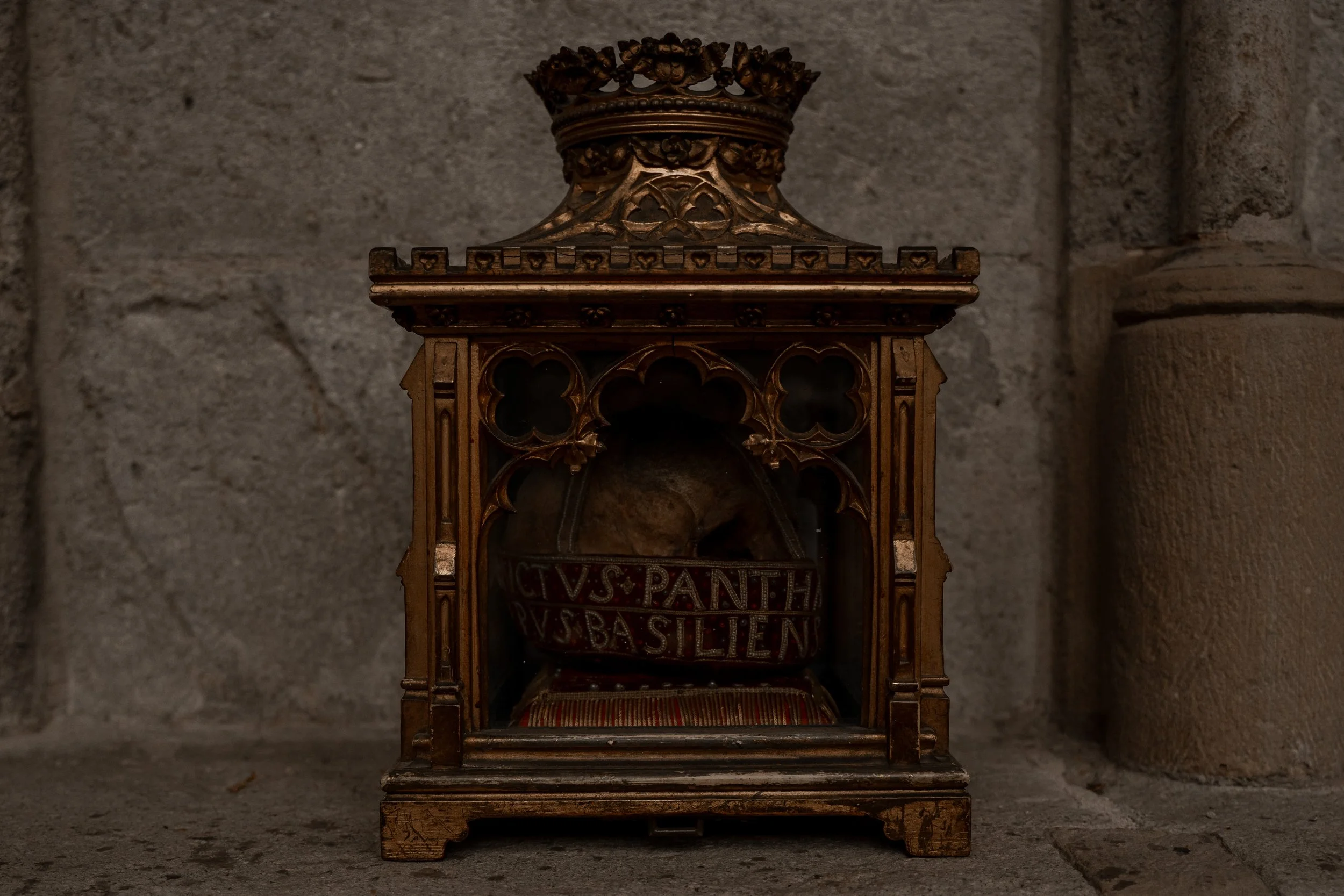
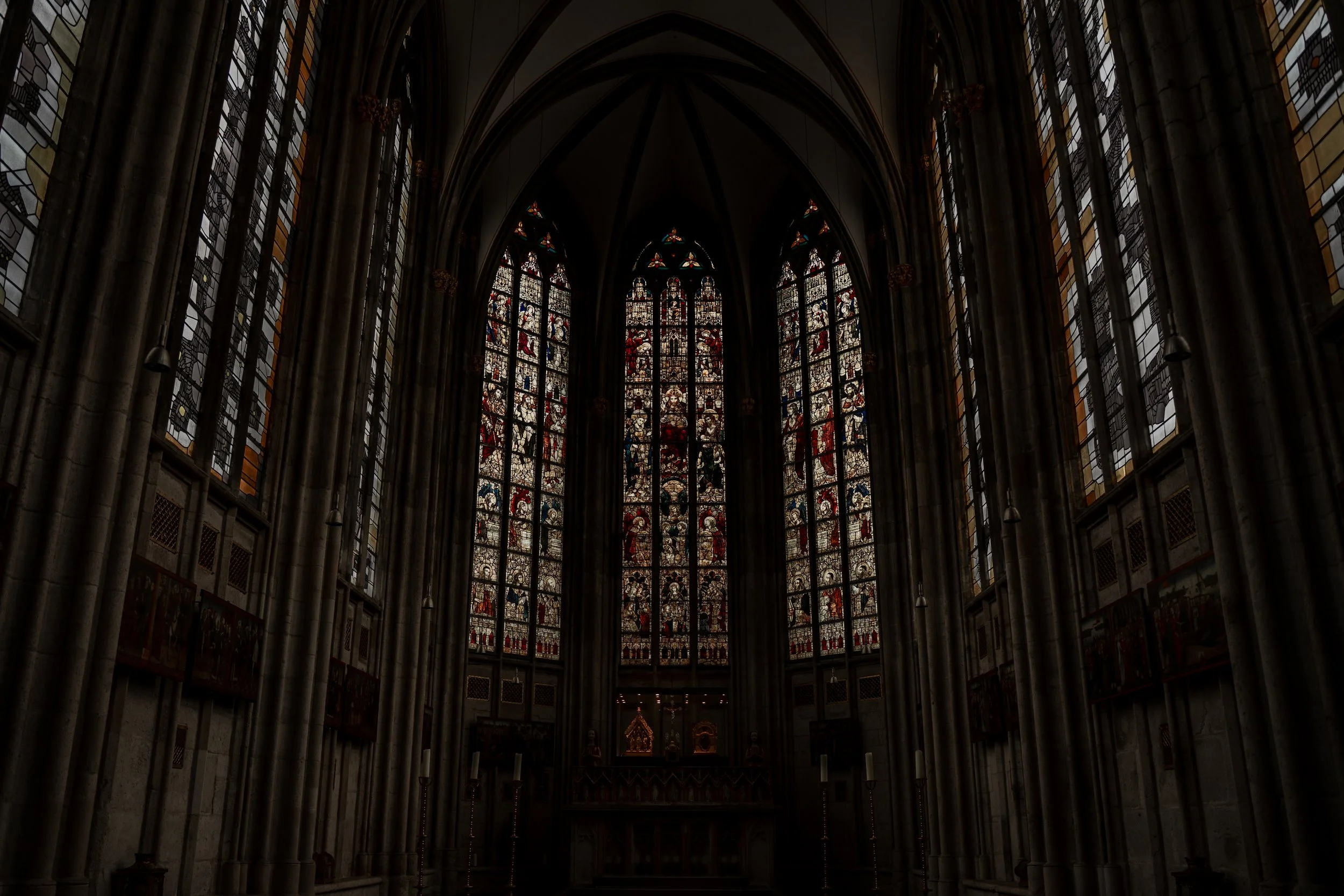
After visiting the chamber, make sure to take time to explore the rest of the church and its extraordinary, layered architecture. One of the most striking contrasts is between the Romanesque nave and the Gothic choir. The nave belongs to the Romanesque tradition, while the choir was rebuilt around 1255, when Gothic architecture was transforming Cologne in time with the construction of the cathedral. Beneath the warmly coloured stained‑glass windows you can also find sacred remains in golden glass reliquaries. Among them is thought to be the relic traditionally identified as the head of St Ursula. The skulls are wrapped in richly embroidered red textiles, making them appear ceremonial rather than simply skeletal. Within the church you can also find the Baroque marble tomb of Saint Ursula.
Address: Ursulapl. 24, 50668 Köln, Germany